

Digital Product Passport: what it is and why it matters for businesses and consumers
For years, product information has been scattered across data sheets, certificates, declarations, labels, manuals, emails and internal documents.
For the consumer, often only the packaging remains.
But that's changing.
In the European Union, the Digital Product Passport (DPP) is becoming a new way to organize, share and verify product information.
And it's not just a tech trend.
It's a regulatory shift that will start affecting different product categories in the coming years. The first major milestone happens on February 18, 2027, when the Digital Product Passport becomes mandatory for certain battery categories. Other sectors, like textiles, tires, aluminum, furniture and energy-related products, will follow progressively.
For businesses, the question is no longer just "what is a DPP?"
It becomes: Is my product ready to have one?
What is a Digital Product Passport?
The Digital Product Passport is a digital record associated with a product that brings together relevant information about its lifecycle, sustainability, composition, compliance and other characteristics defined by the legislation applicable to each category.
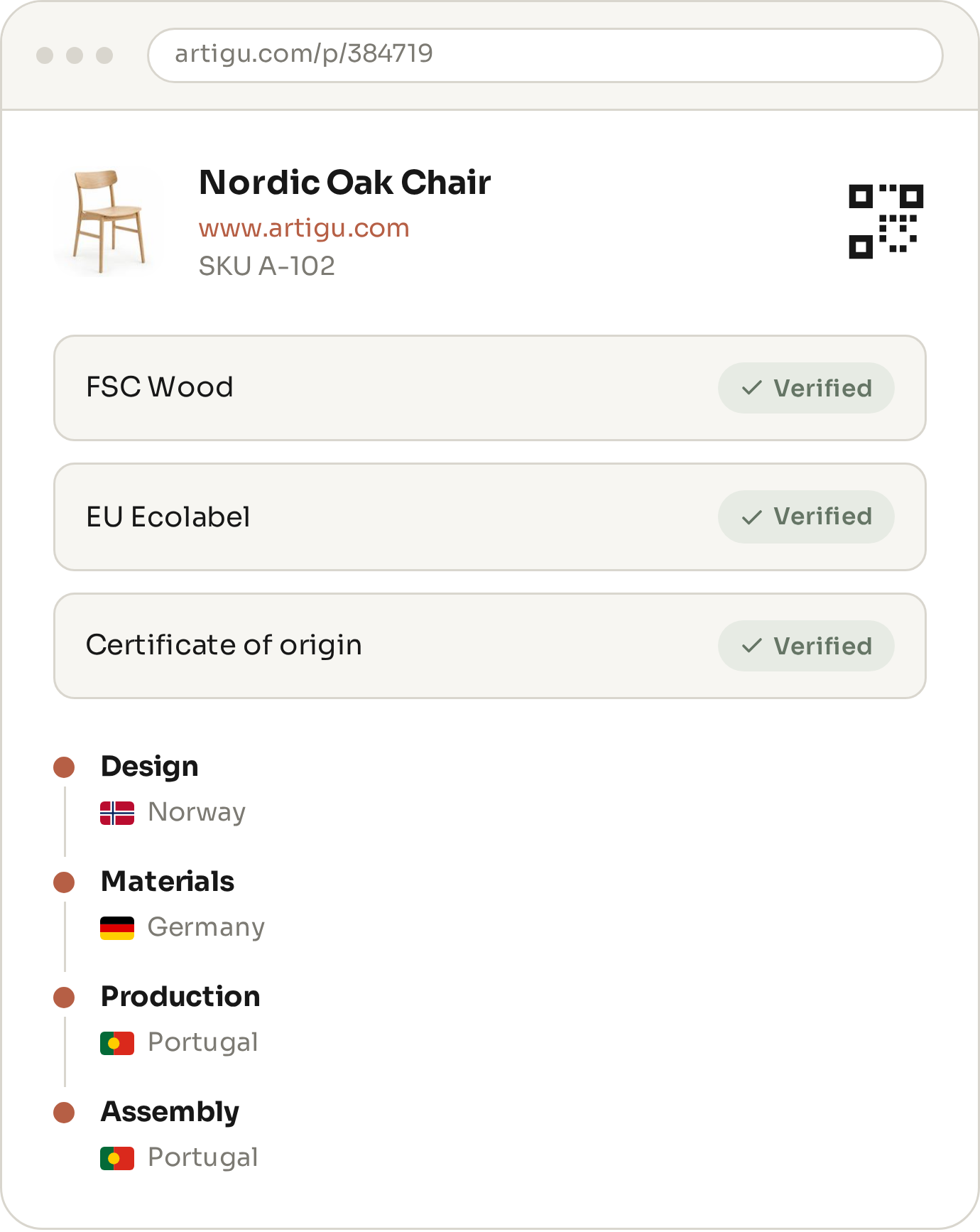
Imagine buying a product and finding a QR Code on the packaging.
When you scan it, instead of just opening a marketing page, you find structured information about that product.
Depending on the product and applicable rules, that information could include:
Manufacturer and origin;
Materials and components;
Technical characteristics;
Safety information;
Compliance documentation;
Certifications and declarations;
Durability and repairability;
Maintenance;
Environmental impact;
Reuse and recycling information;
End-of-life instructions.
It's important to understand one thing: the DPP isn't simply an online PDF.
It's a digital information structure that should allow different stakeholders - businesses, consumers, repairers and authorities - to access the information relevant to each.
What's happening right now?
The European Union is creating an economy where products need to be more transparent, traceable and circular.
The main framework is the Ecodesign for Sustainable Products Regulation (ESPR), which establishes the foundation for the DPP.
But the DPP won't be limited to a single piece of legislation. Specific requirements are also emerging through dedicated legislation for certain categories, including batteries, construction, toys, packaging and other products.
And this is no longer just a future proposal.
The European system already exists.
On July 20, 2026, the European Commission launched the EU Digital Product Passport Registry.
This registry allows economic operators to register DPPs covered by European rules. Detailed product information continues to be maintained by the economic operator or a DPP service provider, while the Registry functions as part of the European registration infrastructure.
In other words, the DPP is already moving from idea to actual European market infrastructure.
What does this mean for a business?
It means product information is starting to become part of the product itself.
Until now, many businesses operate more or less like this:
→ Excel
→ PDFs
→ Certificates
→ Supplier emails
→ Lab tests
→ Data sheets
→ Declarations
→ Production documentation
Everything exists, but scattered.
With the Digital Product Passport, the goal is to create a digital link between the product and the information that proves what that product is.
Product → Information → Evidence → Market
And this is where an opportunity emerges that's much bigger than simply creating a QR Code.
Is the Digital Product Passport a commercial advantage?
It can be.
And this is one of the most interesting parts.
Imagine two nearly identical packages on a shelf.
One says: *Wooden table*
The other lets the customer check:
Identified wood origin
FSC certification
Identified manufacturer
Materials used
Maintenance information
Product documentation
Origin and traceability
Which conveys more trust? **The second one.**
Not because a DPP automatically transforms a product into a better product.
But because it reduces the information asymmetry between seller and buyer.
A consumer looking for a more sustainable option can already search for certifications like FSC, material information, origin or durability. A product that presents verifiable information can differentiate itself from another that simply doesn't explain anything.
The European framework itself aims for the DPP to facilitate more informed purchasing choices through more transparent, comparable and reliable information.
The important point is that the Digital Product Passport doesn't replace certifications like FSC.
A certification remains a certification.
The DPP functions as a way to organize, link and make product information available, and can include references to certifications, declarations, tests and other relevant data.
It's the difference between:
"Trust us." **vs** "Here's the information. See for yourself."
And there's an advantage beyond the consumer
The real potential of the Digital Product Passport lies in traceability throughout the value chain.
A product can involve:
Supplier
↓
Material
↓
Component
↓
Production
↓
Batch
↓
Product
↓
Distribution
↓
Consumer
The DPP can help make that information chain more accessible and structured.
For a business, this could mean:
Locating a component's origin more quickly;
Knowing what documentation is associated with a specific product;
Tracking certifications;
Identifying missing information;
Responding faster to customer requests;
Facilitating audits;
Supporting compliance processes;
Improving supplier management;
Supporting repair and recycling;
Preparing products for new markets.
The European Commission specifically identifies traceability, transparency, efficiency, compliance and improved supply chain management among the potential benefits for economic operators.
To create a useful DPP, a business needs to know:
What product is this?
What materials does it contain?
Who supplied them?
Where was it produced?
What requirements apply?
What documentation proves compliance?
What certifications exist?
When do they expire?
What has changed since the last version?
What information can be made available to each user?
That's why preparing a product for a DPP starts long before generating the QR Code.
Why should you start now?
Even if your product doesn't yet have an immediate DPP obligation, waiting until the obligation date arrives can be a bad strategy.
European implementation is happening progressively.
The European Commission indicates, among other priorities:
2026: iron and steel;
2026–2029: energy-related products;
2027: textiles, tires and aluminum;
2028: furniture;
2029: mattresses and ICT products.
Additionally, there are specific calendars for categories covered by dedicated legislation.
And there's another important detail:
After the adoption of specific acts for each category, economic operators will have a transition period of at least 18 months.
That sounds like a lot of time.
But it's not.
Because a business doesn't start preparing a DPP the moment it receives a QR Code.
It starts when it realizes it doesn't have the data, documents and traceability needed to fill it in.
The product of the future isn't just physical
For decades, the product was what was inside the packaging.
Now a second layer is starting to exist:
The physical product + its digital identity.
That identity can accompany the product throughout its lifecycle.
It can help the consumer decide.
It can help a business demonstrate compliance.
It can help a technician repair.
It can help a recycler identify materials.
It can help an authority verify information.
And it can help the business itself better understand the products it places on the market.
The Digital Product Passport isn't just compliance!
This is probably the most important conclusion.
The DPP is being born for regulatory reasons.
But its value can go far beyond compliance.
It's compliance.
It's traceability.
It's transparency.
It's product information.
It's a new interface between the product and the market.
Businesses that start early have an opportunity to transform a future obligation into useful infrastructure for their own products and a competitive advantage.
Prepare your product before it becomes mandatory
The question isn't just: "When will the DPP be mandatory for me?"
The more important question is: "Do I have the information needed to create one today?"
If the answer is no, that's precisely the problem worth solving now.
The Artigu platform helps businesses organize products, documentation, compliance and traceability - and prepare the next generation of Digital Product Passports.
Want to understand what the DPP means for your products?